SerenityGPT overview
SerenityGPT is an AI layer for enterprises that enables rapid configuration of AI use cases while meeting strict requirements for data privacy, governance, auditability, and observability. The same core technology applies consistently across departments, datasets, and use cases. SerenityGPT is particularly well suited for private equity firms deploying AI across their portfolio companies, for financial institutions rolling out AI across many departments and use cases, and for healthcare organizations supporting a wide range of clinical and administrative use cases.
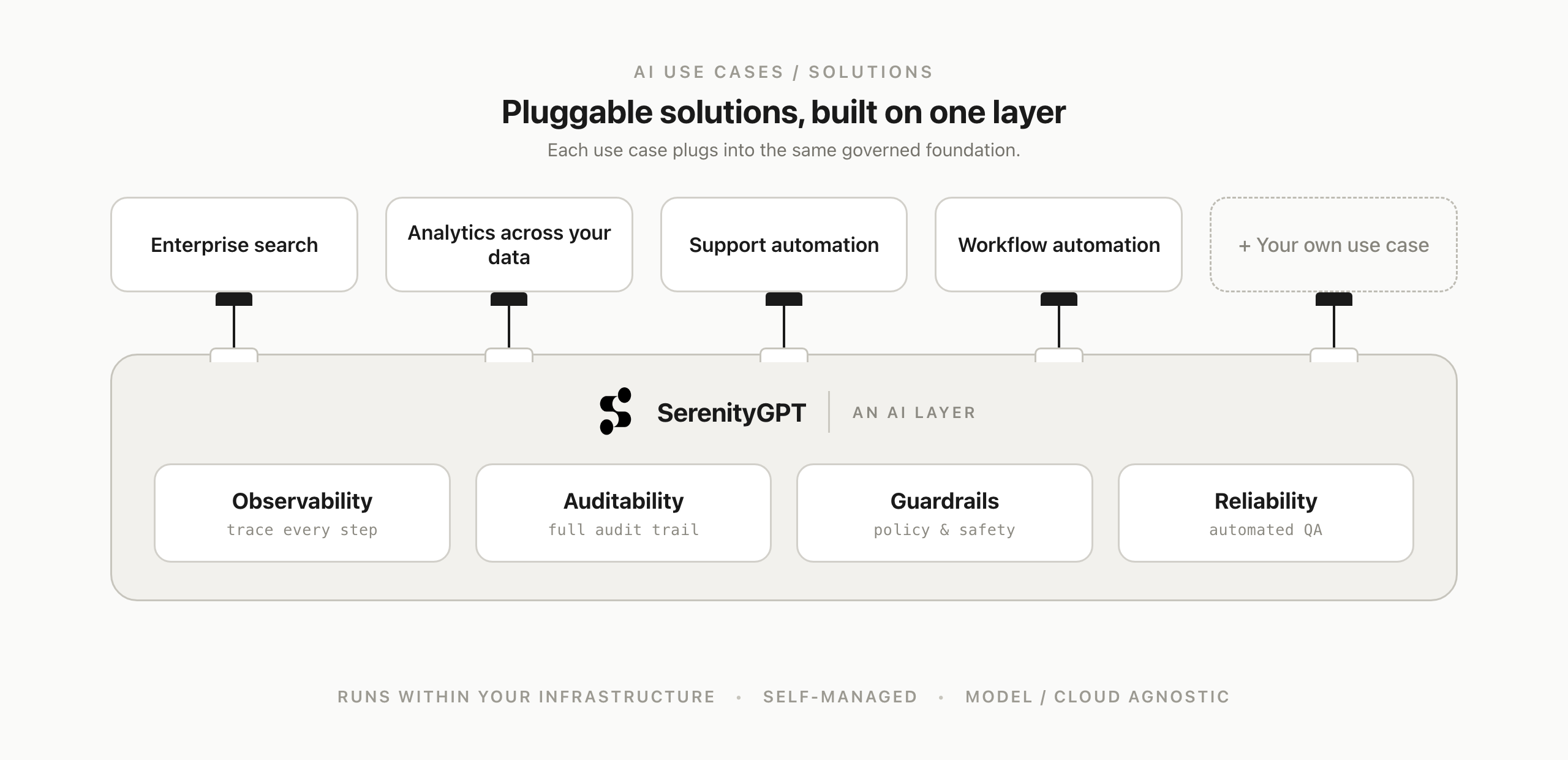
The following diagram shows how AI use cases plug into the SerenityGPT layer, which provides retrieval, observability, auditability, explainability, guardrails, reliability, and analytics across all of them.
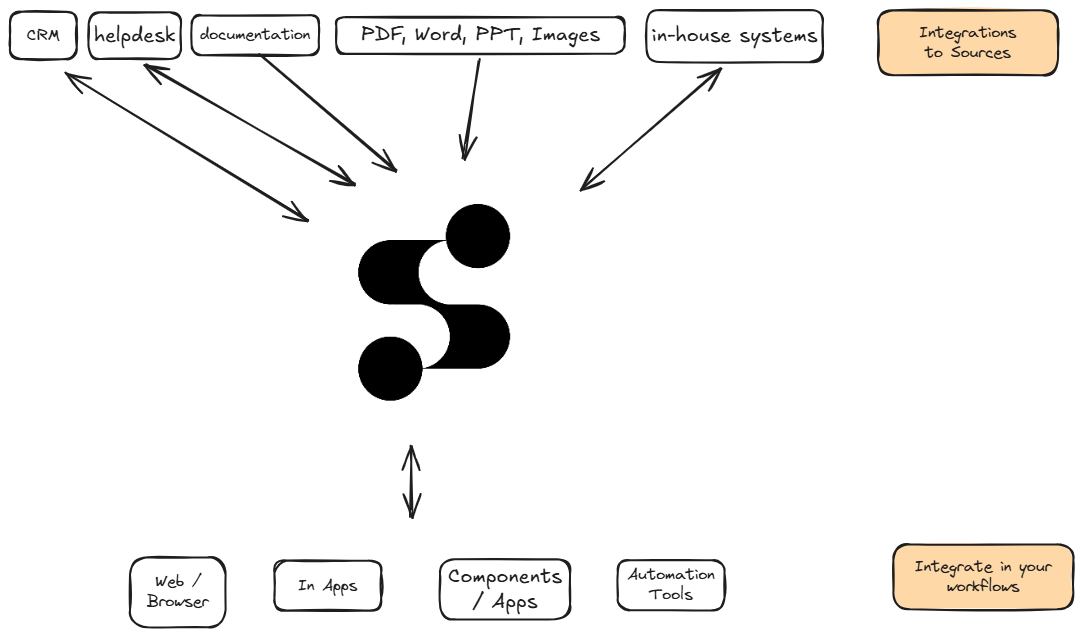
The following diagram shows how SerenityGPT fits into your environment at a high level.
Core functionality
Natural language answers over your internal knowledge
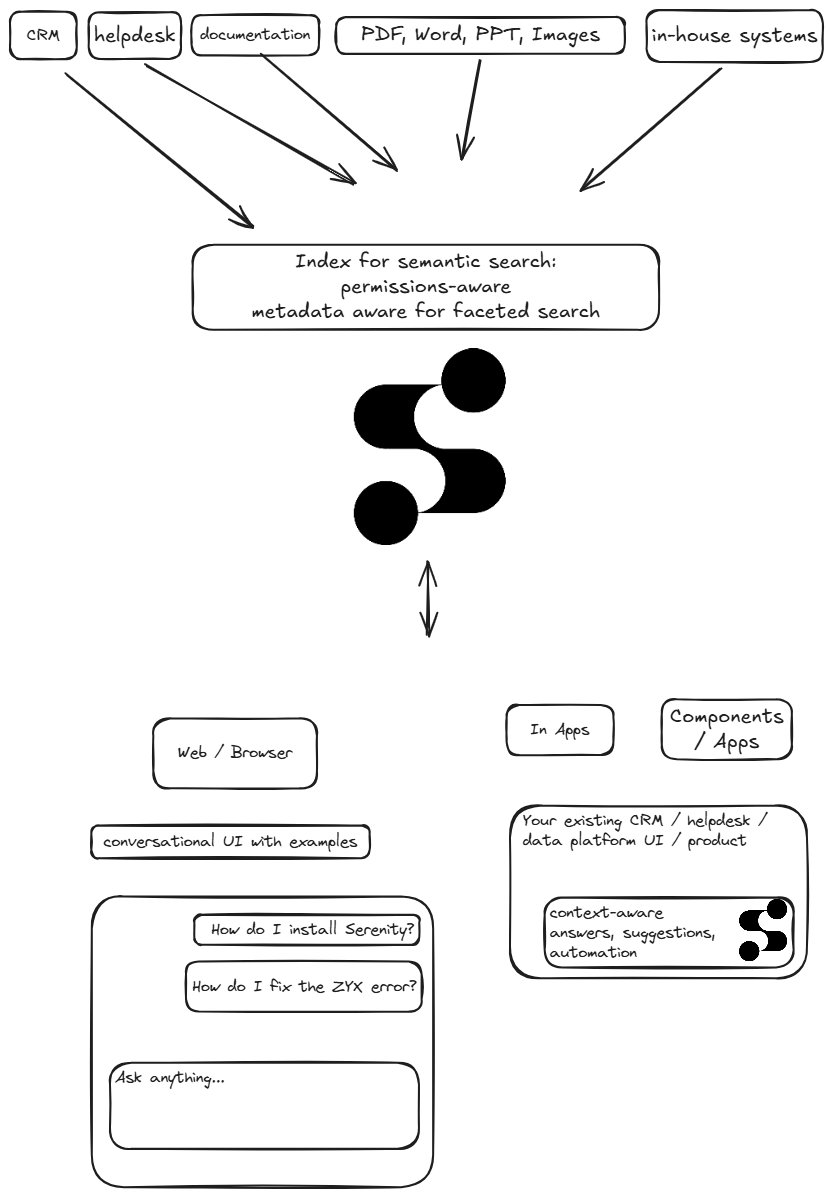
SerenityGPT replaces scattered keyword searches across tools with a single chat experience: ask in plain English like you would a colleague, instantly get exactly what you need, and see citations back to the original source.
The following diagram shows how SerenityGPT retrieves and generates answers from your internal knowledge sources.
Common use cases
-
Customer self-service and support deflection. Give customers instant, accurate answers from product documentation, knowledge bases, and support content, reducing ticket volume and time to resolution.
-
Internal knowledge assistant. Help employees search across policies, manuals, runbooks, wikis, and other internal systems using natural language, with answers grounded in the right documents.
-
Agent assist for support and operations teams. Surface relevant answers, articles, and next steps directly inside existing workflows such as Salesforce, Jira, or help desk tools.
-
Legal document search and review. Help legal teams quickly find clauses, obligations, renewal terms, counterparties, and other key information across contracts, NDAs, policies, and broader legal documentation using natural language search.
Metrics to track
- Answer correctness on a golden set.
- Ticket deflection / self-service resolution rate.
- Identification of documentation gaps.
- Thumbs up/down and feedback for AI answers.
ROI
- Lower support costs with fewer tickets, fewer escalations, and faster resolution.
Ask and analyze across enterprise systems
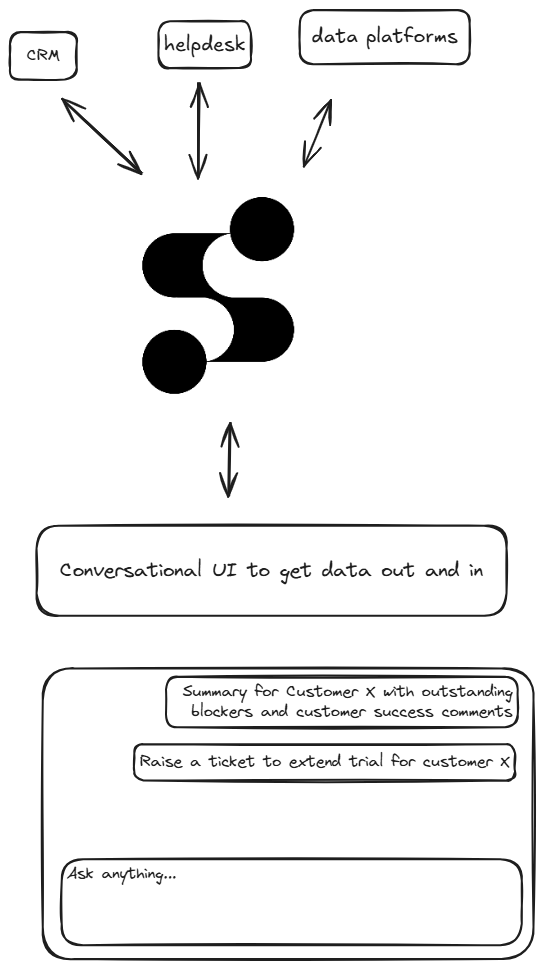
A single conversational window into CRM, ticketing, data platforms, and internal tools, with permission-aware results and actions.
Beyond retrieving individual records, SerenityGPT analyzes the data across systems and answers the kind of question normally sent to an analyst or a data scientist. It queries the connected sources, aggregates and correlates the results, and returns an answer in seconds instead of days. For example:
- What are our most popular products?
- Which issues came up most often in the last month?
- Which events may signal that a customer will churn?
- How much time did senior engineers spend on project X in the last two weeks?
Answers include the underlying figures and links to the records they came from, so users can verify the result.
The following diagram shows how SerenityGPT connects to your enterprise systems through a single chat interface, and how it answers analytical questions across them.
Common use cases
-
Sales and account management. Summarize account activity, highlight renewal risks, and surface the latest customer issues, opportunities, and interactions across CRM, support, and related systems. Answer aggregate questions such as which accounts show churn signals, or how win rates differ by segment and period.
-
IT and operations. Investigate incidents, review deployment changes, and find postmortems, runbooks, and system knowledge through a single chat interface. Identify the most frequent incident causes, track how resolution times move over time, and see which services generate the most tickets.
-
Finance and operations reporting. Answer aggregate questions across finance, HR, and project systems, such as how much time senior engineers spent on a project in the last two weeks, or how spend per team changed quarter over quarter.
-
Product and project management. Pull together tickets, support trends, feature requests, delivery status, blockers, and team activity from ticketing platforms and help desks in one place. Rank feature requests by how often customers raise them, identify the issue categories that grew most in the last month, and compare delivery throughput across teams.
Metrics to track
- Time to complete common tasks.
- Usage: number of queries and types of queries.
- Analytical questions answered without an analyst request.
- Time from question to answer, compared with the previous reporting process.
ROI
- Increased productivity.
- Reduced burden on internal Salesforce/Jira/etc teams.
- Fewer ad hoc requests to analytics and BI teams.
- Faster decisions, because answers arrive in seconds rather than days.
Automate repeatable tasks and workflows
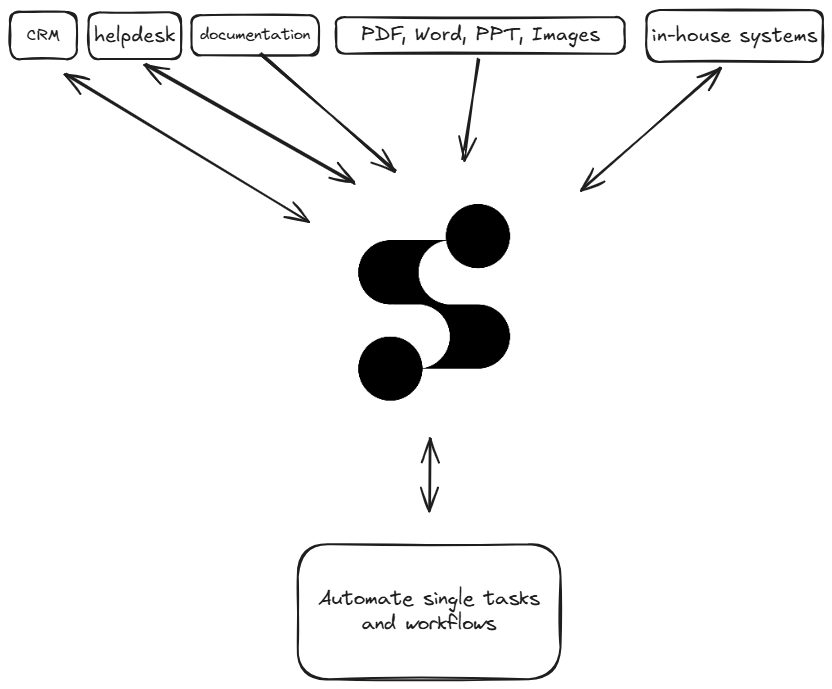
Anything repeatable that has to do with unstructured data can be automated securely within you infrastructure with full observability and confidence in the results. Configure guardrails for additional protection.
The following diagram shows how SerenityGPT delivers agentic AI over enterprise data, with observability, governance, guardrails, and performance guarantees built in.
Common use cases
-
Document and data extraction. Extract structured data from financial statements, tax documents, payslips, forms, diagrams, floorplans, and other unstructured files.
-
Triage and routing. Classify incoming requests, detect missing information, route items to the right queue, and raise exceptions when rules are not met.
-
Report preparation. Generate structured summaries, analysis, and first drafts from enterprise documents, internal systems, and other connected data sources.
-
RFI, RFP, and SOW preparation. Draft responses to RFIs and RFPs and prepare statements of work using internal content, standard language, and prior materials.
Metrics to track
- Extraction accuracy.
- Time to prepare a report / fill in RFP / etc.
- Exception rate / how often guardrails trigger.
ROI
- Reduced manual handling time.
- Capacity to scale without growing the team.
- Faster turnaround.
- Fewer errors.
What makes SerenityGPT different
- Turnkey, not DIY. SerenityGPT delivers ready-to-use solutions, not a generic toolkit that requires significant effort and expertise to assemble.
- Runs in your infrastructure. Unlike SaaS offerings, SerenityGPT operates entirely within the customer's environment. No data leaves the network.
- Self-management option. Organizations can fully own and operate the product independently, an option rarely available from other vendors.
- Fast implementation. New use cases go from concept to production in days, not months.
- One platform for all use cases. A single configurable platform serves every department, dataset, and portfolio company. All ingested data and components are reusable across use cases, eliminating the need to onboard separate vendors or re-ingest data for each new requirement.
Evaluation system
A core component of SerenityGPT is an automatic evaluation system that measures AI performance per use case and dataset. The system evaluates correctness of answers, accuracy of field extraction from PDFs and images, and outcomes of automation. Over 50 golden sets have been accumulated across use cases and datasets to validate configuration changes before they reach production.
Flexible delivery model
-
Turnkey, white-glove delivery. For organizations that want a fully managed experience, SerenityGPT provides turnkey solutions and manages delivery end to end.
-
Self-managed after initial setup. For organizations that want to build and expand on their own, SerenityGPT provides the initial configuration and foundation, after which internal teams can self-manage and extend the system.
Many of our customers are internal AI teams. We help them move much faster by providing the core platform, patterns, and configuration upfront, so they do not have to reinvent the wheel.
Live example
Perforce's Puppet documentation site at help.puppet.com features a public-facing chatbot powered by SerenityGPT. Click the search box to try it.